
English


| Quantity: | |
|---|---|


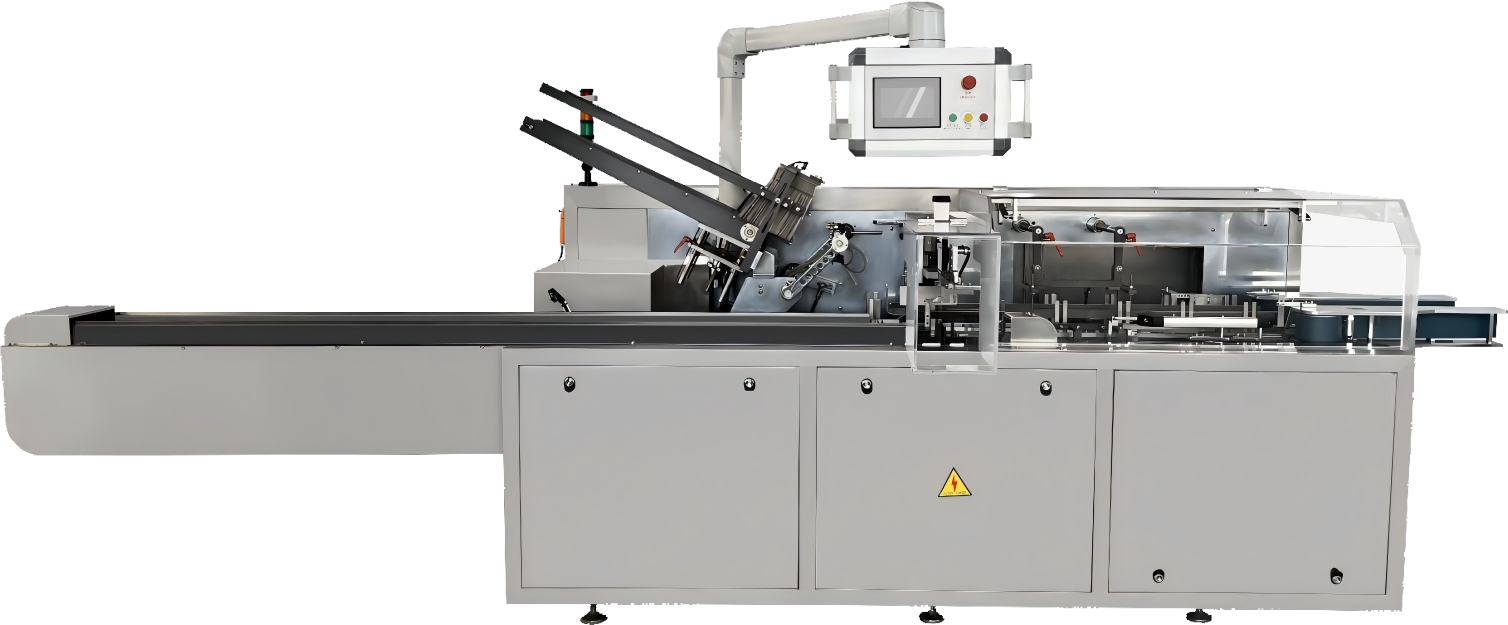
The HY-130B is an automatic tongue-insertion carton sealing machine built for continuous carton closing operations in industrial packaging lines. Designed and manufactured by Zhejiang Haoyuan Machinery, the unit uses vacuum-assisted pre-break technology to fold and tuck carton flaps, producing consistently sealed boxes across production runs.
Equipped with PLC programming and a touchscreen HMI, the machine allows operators to set and store parameters for different carton dimensions. Electrical components include Omron inverter, PLC, and touchscreen units, paired with Sick photoelectric sensors for product detection. The equipment serves food, healthcare, and consumer goods sectors where carton sealing is part of end-of-line packaging workflows.
Parameter | HY-130B Tongue-Insertion Box Sealer |
|---|---|
Operating speed | 30-60 boxes/min |
Carton material requirement | 250-450 g/m² (confirmed by carton dimensions) |
Carton dimension range | (100-300) mm × (60-120) mm × (30-70) mm; custom sizes available on request |
Required air pressure | ≥ 0.6 MPa |
Air consumption | 20 m³/h |
Voltage | 380 V, 50 Hz |
Motor power | 1.5 kW |
Machine dimensions | 4200 × 1350 × 1900 mm (L × W × H) |
Machine weight | 1500 kg |
 |  |
 |  |
The touchscreen human-machine interface provides access to speed settings, delay timers, and production counters. The PLC coordinates all motion sequences, including carton feeding, flap folding, and tongue insertion.
Omron-supplied electrical components — including inverter, PLC controller, and touchscreen — manage drive and control functions. Sick photoelectric sensors detect carton position and product presence along the production path.
The machine accommodates cartons within the (100-300) mm × (60-120) mm × (30-70) mm range. Dimension adjustments are made via mechanical guides and saved parameter profiles. Custom dimension configurations are available for dedicated product lines.
Photoelectric sensors verify product presence inside each carton. If no product is detected, the machine skips the sealing cycle for that carton, reducing material waste from empty sealed boxes.
The control system displays fault messages on the HMI when anomalies occur, and triggers an audible alarm. A built-in counter tracks finished box output for production reporting and shift tracking.
Motor overload protection interrupts power when current exceeds rated thresholds, protecting drive components from damage during jam conditions or unexpected load increases.
Vacuum suction holds and pre-folds carton top flaps before tongue insertion. This mechanism supports clean fold lines and consistent tuck positioning across carton batches.
The machine seals cartons for packaged food products including paper straw boxes, snack packages, and beverage multipacks, supporting end-of-line packaging for food manufacturing operations.
For infant nutrition powders, probiotic supplements, and vitamin products, the sealer closes secondary cartons with consistent tuck-in seals suitable for distribution and retail display.
The equipment handles paper-based cartons for recyclable and environmentally positioned consumer goods, where folded-tongue closures replace adhesive sealing methods.
 |  |  |  |
The machine operates at 30-60 boxes per minute, with actual output determined by carton size, material stiffness, and upstream feeding consistency.
The sealer works with carton board in the 250-450 g/m² grammage range. Final material compatibility is confirmed based on specific carton dimensions and flap geometry.
Photoelectric sensors check for product inside each carton before the sealing station. When no product is detected, the carton passes through without vacuum activation, preventing wasted cartons and sealing cycles.
The machine uses Omron electrical components including the inverter, PLC controller, and touchscreen HMI, along with Sick photoelectric sensors for detection functions.
Yes, the standard range covers (100-300) mm × (60-120) mm × (30-70) mm. Custom mechanical configurations for other carton sizes can be specified during the procurement process.


