
English
Views: 0 Author: Site Editor Publish Time: 2026-07-09 Origin: Site


Primary packaging dictates pharmaceutical integrity, shelf-life stability, and regulatory compliance. Solid dose manufacturing facilities constantly balance the demand for high-speed output against strict cGMP compliance. You need minimal material waste while managing the operational reality of frequent format changeovers. Selecting the right equipment solves these bottlenecks and prevents costly moisture ingress or barrier failures that lead to batch recalls. This guide provides a technical framework for evaluating specifications and mechanical capabilities before you procure a hard blister packing machine. We cover everything from forming mechanics and web tension control to inline inspection systems and validation protocols. Understanding these engineering dimensions ensures your packaging line operates at peak efficiency.
Material compatibility requirements (thermoforming vs. cold forming) dictate the necessary heating, forming, and sealing station architectures.
The level of servo-driven automation directly impacts Overall Equipment Effectiveness (OEE), labor overhead, and synchronization with downstream cartoning.
Tooling changeover speed, clean-in-place (CIP) accessibility, and tool-less designs are critical financial levers for multi-product facilities.
Regulatory compliance is non-negotiable; machine control software must support FDA 21 CFR Part 11 requirements, backed by robust IQ/OQ/PQ documentation.
Calculating required blisters per minute (BPM) establishes your baseline. You must weigh this theoretical maximum against actual operational throughput and historical OEE. A machine rated for 400 BPM might only yield 250 BPM when factoring in material splicing, web alignment corrections, and routine stops. You need to account for accumulator boxes and splicing tables that keep the line running during roll changes. Assess footprint-to-output ratios carefully. Cleanroom floor space remains highly restricted and expensive to maintain. You want maximum yield per square meter without crowding operator access panels.
Determine your requirements for continuous motion versus intermittent motion. Continuous motion suits massive commercial batches where the web never stops moving, allowing for higher speeds and smoother material handling. Intermittent motion provides the extended dwell times necessary for complex cold-forming, deep-draw cavities, or smaller, highly variable product batches. When evaluating scalability, consider the following operational factors:
The maximum web width the machine can handle without causing material sag.
The index length per cycle, which determines how many blisters are punched per stroke.
The capacity of the chilled water system to keep up with increased heating loads at higher speeds.
The integration speed of downstream cartoners to prevent bottlenecking at the discharge chute.
Evaluate the operational need for a dedicated alu-pvc blister packing machine. Sometimes a hybrid system capable of switching to cold-form Alu-Alu makes more sense for multi-product facilities. Analyze cavity depth limitations and material shrinkage tolerances. Web width constraints directly impact how many solid dose forms you can pack per cycle. Capsules, large oblong tablets, and softgels all require specific draft angles in the forming molds to release properly. Deep cavities often require plug-assist forming mechanisms to prevent the plastic film from thinning out at the corners.
Future-proof your line for advanced barrier films like Aclar or high-barrier PVDC. Emerging sustainable, recyclable mono-materials require highly precise temperature controls to prevent warping during the thermoforming phase. If your heating plates fluctuate by even a few degrees, these sensitive mono-materials will curl and jam the indexer. You must match the machine's heating architecture to your primary film type.
Material Forming Specifications
Material Type | Forming Method | Heating Requirement | Typical Application |
|---|---|---|---|
Standard PVC | Thermoforming | Contact Heating (130°C - 150°C) | Standard tablets, low moisture sensitivity |
PVDC / PETG | Thermoforming | Radiant Heating (Precise control) | Moderate barrier requirements |
Aclar | Thermoforming | Radiant Heating (Slow ramp-up) | High moisture barrier, clear visibility |
Alu-Alu (Cold Form) | Mechanical Stamping | None (Ambient) | Extreme moisture/light sensitivity |
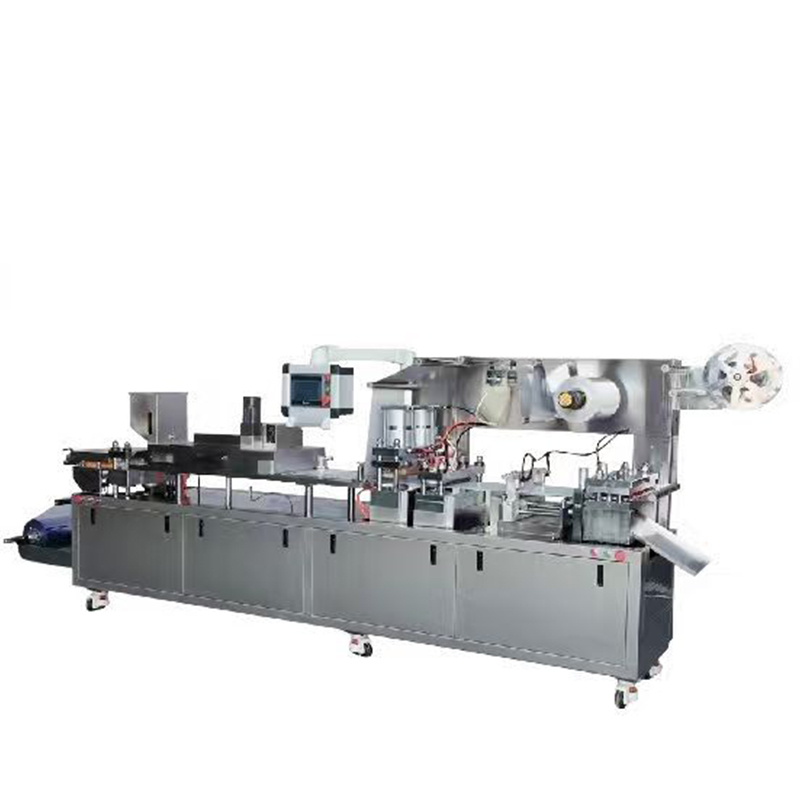
The operational leap from semi-automatic to fully automatic systems transforms facility output. Eliminating human intervention from feeding to discharging drastically reduces contamination risks and particulate generation. An automatic hard blister packing machine synchronizes every station through a centralized PLC. Compare mechanical cam-driven systems against fully servo-driven architectures. Cam drives offer robust simplicity for single-product lines. Servo drives provide unmatched precision, easier recipe adjustments via the HMI, and better lifecycle longevity due to fewer moving mechanical parts.
Servos utilize closed-loop feedback to adjust web tension on the fly. Consider integration capabilities early in the design phase. Direct feeds from tablet presses streamline bulk handling. Seamless handoffs to downstream secondary packaging prevent bottlenecking at the discharge chute. A fully integrated line requires specific handshake protocols between machines:
Upstream bulk feeders must communicate fill levels to the blister machine's hopper.
The blister machine's discharge conveyor must match the pitch and speed of the cartoner's bucket infeed.
Reject stations must isolate defective blisters before they reach the cartoner to prevent empty boxes.
The central line controller must aggregate alarm data from all connected machines for unified troubleshooting.
High-yield systems manage continuous commercial-scale production without faltering. A dpp-420 hard blister packing machine exemplifies this scale, utilizing a wide web to punch multiple blisters across the index. This maximizes the number of packages produced per stroke. Evaluate flat-plate sealing versus rotary sealing technologies. Flat-plate sealing works better for Alu-Alu and complex shapes due to higher, sustained clamping pressure. Rotary sealing optimizes high-speed Alu-PVC runs by continuously rolling the lidding foil over the formed web.
Index length specifications dictate how much material pulls through per cycle. Optimizing this length improves material yield and drives down web waste. Precision indexers ensure the printed lidding foil aligns perfectly with the formed cavities every single time. When running printed foil, the machine relies on a registration mark sensor to adjust the index length dynamically, compensating for minor stretching in the aluminum web.
Flat-Plate Sealing vs. Rotary Sealing Comparison
Feature | Flat-Plate Sealing | Rotary Sealing |
|---|---|---|
Motion Type | Intermittent | Continuous |
Best Material Match | Alu-Alu, Complex PVC, Aclar | Standard Alu-PVC, PETG |
Sealing Pressure | High, sustained dwell time | Moderate, brief contact |
Production Speed | Medium to High | Very High |
Tooling Complexity | Heavier, requires precise leveling | Lighter, requires precise tension |
Preheating station precision dictates forming quality. Temperature uniformity prevents thin spots in the blister cavities, which compromise the moisture barrier. Choose between contact and radiant heating based on your primary film. Contact heating works well for standard PVC, transferring heat directly through physical touch. Radiant heating handles sensitive PVDC or PETG films better, preventing material sticking and degradation. Automated feeding systems require careful selection based on product geometry. You must match the feeder to the physical characteristics of the solid dose.
Dedicated brush boxes with planetary agitators work best for standard round tablets that can withstand mechanical sweeping.
Dedicated tube feeders protect fragile capsules and coated tablets from denting or chipping during the fill cycle.
Vibratory tracks align complex geometries, oblongs, and softgels, ensuring they drop perfectly flat into the cavities.
Syringe or ampoule feeders require robotic pick-and-place mechanisms to prevent glass breakage.
Sealing pressure calibration and dwell time controls ensure verifiable, leak-proof barrier integrity. Knurling patterns must interlock perfectly across the web. Pyramid knurling provides aggressive sealing for tough foils, while cross-hatch patterns offer a cleaner aesthetic for standard PVC. A blister packing machine must maintain equal pressure across the entire sealing plate to prevent micro-leaks on the outer edges of the web.
Cooling station mechanics lock in the seal immediately after the heating plates. Chilled water loops rapidly set the heated polymers. This prevents material warping and ensures long-term shelf-life stability. The flow rate and temperature of this chilled water must be strictly monitored by the PLC. If the water temperature rises above the setpoint, the PVC will remain pliable, causing the web to stretch and misalign at the punch station.
Embossing and perforating stations integrate legible batch coding and expiration dates directly into the foil. Tear-line perforations must cut cleanly without compromising the primary seal integrity or creating foil dust. Cutting and punching precision relies on robust progressive die-cutting mechanisms. You need clean blister edges every time to prevent feeding jams in the downstream cartoner. High-quality, hardened steel dies minimize web waste and keep scrap rates strictly controlled. Progressive punching reduces the mechanical stress on the web, preventing micro-fractures in the aluminum lidding.
Inline camera vision systems act as the primary defense against defective batches. Specify high-resolution, multi-spectrum cameras for detecting missing, broken, or incorrect color products before the sealing station. These systems use pixel-counting algorithms to verify product size and shape. Automated pinhole detection systems remain mandatory for Alu-Alu cold forming. Even microscopic fractures compromise the moisture barrier. These detectors use high-intensity infrared light to spot breaches in the foil.
Reject station mechanics rely on shift-register verification. The PLC tracks defective blisters through the index using encoder feedback. It isolates and discharges them at the punch station without halting the entire production line. This continuous rejection logic is critical for maintaining high OEE during minor feeding errors. The system must physically separate rejected blisters into a locked, secure bin to comply with cGMP reconciliation requirements.
Inline Inspection Technologies
Inspection Type | Target Defect | Technology Used | Action Taken |
|---|---|---|---|
Color Vision Camera | Wrong product, mixed batch | Multi-spectrum pixel analysis | Shift-register reject at punch |
Fill Verification | Missing or broken tablets | High-contrast overhead lighting | Shift-register reject at punch |
Pinhole Detection | Micro-fractures in Alu-Alu | Infrared light transmission | Immediate line stop or reject |
Splice Detection | Tape joints in material web | Ultrasonic or optical sensors | Automatic reject of spliced section |
Advanced automation directly improves operational efficiency on the packaging floor. Servo-driven stations reduce mechanical wear, eliminate backlash, and stabilize OEE over the machine's lifespan. Utility consumption requires detailed engineering analysis. Evaluate the energy requirements for heating and cooling stations. Chilled water loops and compressed air dependencies draw significant facility resources. Specify lubrication-free pneumatics to maintain cleanroom air quality standards (ISO 8573-1). A machine that consumes excessive compressed air will strain your facility's utility infrastructure.
Smart manufacturing investments provide measurable operational returns. IoT-enabled predictive maintenance monitors servo torque limits and heater band resistance. Real-time field data monitoring helps maintenance teams prevent catastrophic downtime before components fail. When a servo draws more current than usual, the system flags a potential bearing failure weeks before it stops the line. This data-driven approach shifts maintenance from reactive firefighting to planned interventions.
Custom blister molds, guide tracks, and cutting dies represent significant lifecycle mechanics. Every new product introduction requires dedicated tooling sets machined to exact tolerances. Evaluate the reality of tool-less changeover designs. True tool-less systems utilize quick-release clamps, pneumatic locks, and pre-calibrated alignment pins. This measurable impact on batch-to-batch downtime keeps the line running and increases overall capacity. Heavy, bolted tooling blocks extend changeovers from minutes to hours.
Ensure operators can swap forming plates, sealing plates, and punching dies without specialized hand tools. Teflon-coated heating plates prevent PVC buildup, reducing the time operators spend scrubbing components during format changes. A streamlined changeover process involves specific, repeatable steps:
Purge the machine of all previous product and packaging materials.
Release the pneumatic locks on the forming, sealing, and punching stations.
Slide out the old tooling blocks onto a dedicated transport cart.
Slide in the new pre-heated tooling blocks and engage the pneumatic locks.
Load the new recipe on the HMI to automatically adjust servo positions and index lengths.
Thread the new forming film and lidding foil through the tension rollers.
Mitigate qualification delays by requiring comprehensive Factory Acceptance Testing (FAT). Do not ship the machine until it runs your specific product flawlessly at the OEM facility. Execute both dry runs and wet runs using actual production materials. Challenge the vision system with intentionally defective tablets to verify the reject logic. Demand standard IQ/OQ/PQ documentation upfront to streamline site validation. A rigorous FAT protocol should include:
Continuous running at maximum rated speed for at least four hours to monitor heat buildup.
Verification of all emergency stop circuits and safety interlocks.
Testing the shift-register reject system with consecutive and random simulated defects.
Measuring the actual chilled water and compressed air consumption against the stated specifications.
Software compliance presents a major regulatory hurdle for pharmaceutical manufacturers. Ensure the HMI and PLC support comprehensive audit trails and electronic signatures. Role-based access must align strictly with FDA 21 CFR Part 11 requirements. Operators, supervisors, and maintenance personnel must have distinct login credentials with restricted parameter access. Any change to a sealing temperature or dwell time must be logged with a timestamp and user ID.
Recipe management on the HMI dictates the learning curve for line operators. Complex, nested menus cause setup errors and parameter drift. Intuitive, graphical interfaces reduce training time and standardize startups. The shift from manual mechanical adjustments to digital recipe loading requires a different operator skillset. Supply chain risks threaten uptime. Verify the availability of proprietary spare parts before signing the procurement contract. Localized technical support prevents extended downtime during critical electrical failures.
Assess the feasibility of in-house preventive maintenance. Your technicians must understand the pneumatic manifolds, servo drives, and PLC logic to keep the equipment running at peak capacity. Establish a strict preventive maintenance schedule for replacing heater bands, sharpening punch dies, and calibrating sealing pressure load cells. Routine maintenance tasks include:
Inspecting the Teflon coating on heating plates for scratches or wear.
Calibrating the sealing station load cells to ensure uniform pressure distribution.
Checking the tension on all web guide rollers to prevent material tracking issues.
Cleaning the camera lenses and lighting arrays on the vision inspection system.
Lubricating the linear bearings on the punch station guide rails.
Draft a comprehensive User Requirement Specification (URS) detailing your exact film types, required draft angles, and throughput needs.
Request sample tooling runs from the manufacturer using your most difficult-to-feed solid dose product.
Schedule rigorous FAT protocols that test the machine at maximum rated speeds for sustained periods to monitor heat buildup.
Verify that all inline vision and pinhole detection systems integrate seamlessly with the main PLC reject shift-register.
Establish a preventive maintenance schedule specifically targeting punch die sharpening and heater band calibration.
A: An Alu-PVC machine uses heat to thermoform plastic cavities before sealing them with aluminum lidding. An Alu-Alu machine uses mechanical force to cold-form aluminum foil cavities without heat. Alu-Alu provides superior moisture and light barriers but requires larger blister footprints and specific pinhole detection systems.
A: True throughput equals the theoretical blisters per minute (BPM) multiplied by the historical Overall Equipment Effectiveness (OEE) percentage. You must subtract downtime for material splicing, tooling changeovers, web alignment corrections, and routine maintenance to find the actual operational yield.
A: Modern machines with tool-less designs, pneumatic locks, and quick-release mechanisms typically complete format changeovers in 30 to 45 minutes. Older, bolt-heavy systems can take several hours. Servo-driven recipe management on the HMI further reduces startup calibration time.
A: The DPP-420 features a significantly wider web width and longer index length. This accommodates more blisters per punch cycle, making it ideal for high-volume, continuous commercial production. Smaller models prioritize compact footprints and rapid changeovers for smaller batch sizes.
A: cGMP compliance requires high-resolution camera vision systems to detect missing, broken, or incorrect products before sealing. Cold-form Alu-Alu lines also mandate automated pinhole detectors to ensure the primary moisture and light barrier remains completely uncompromised.
A: Heating stations ensure the forming film reaches the exact glass transition temperature for uniform cavity thickness. Post-seal cooling stations use chilled water loops to rapidly set the polymers. This prevents material warping and guarantees a leak-proof barrier for maximum shelf-life.
A: The sequence includes unwinding the forming film, preheating, forming the cavities, automated product feeding, inline vision inspection, applying the lidding foil, heat sealing, cooling, embossing batch data, perforating tear-lines, and finally die-punching the finished blisters.


