
English


This machine designed for wet wipes from making to packaging.It adapts vertical folding and down film feeding institution. Machine runs fast, smoothly, and can automatically accomplish:Non-woven fabrics adding liquid → wet wipes folding →slicing → bag making and sealing which can effectively avoid the secondary pollution of packing process.
| Quantity: | |
|---|---|


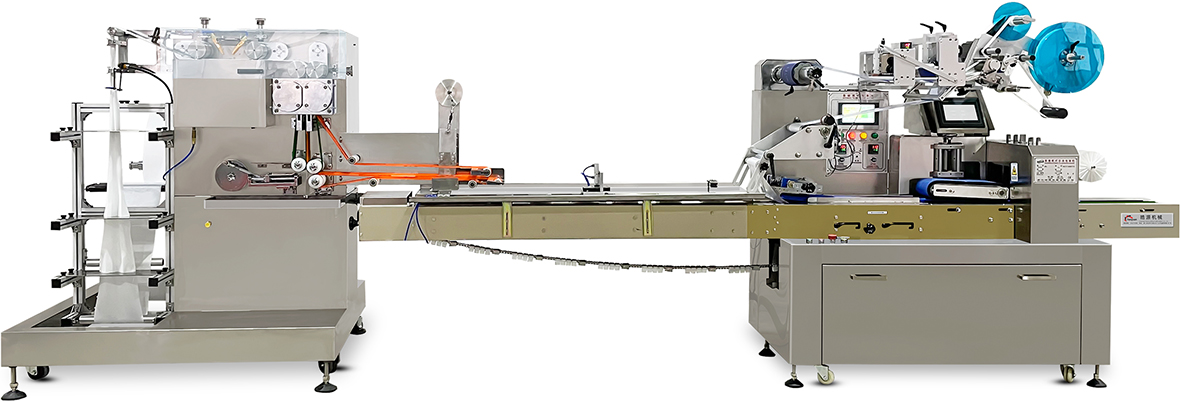
The JBK-260 is an integrated single-piece wet wipe production machine that performs liquid infusion, folding, slicing, bag forming, and sealing in a continuous automated sequence. Manufactured by Zhejiang Haoyuan Machinery, the unit uses a vertical folding mechanism and down film feeding system to process non-woven fabric into individually packaged wet wipes.
The enclosed workflow transfers material between stations without manual handling, reducing exposure to airborne contaminants during packaging. This configuration supports hygiene-focused production for baby care, skin cleansing, and disinfectant wipe products. The machine serves daily chemical factories, maternal and infant product manufacturers, and private label hygiene suppliers for commercial production.
Parameter | JBK-260 Single-Piece Wet Wipes Machine |
|---|---|
Packaging speed | 100-250 bags/min |
Folded wipe dimensions | L: 50-250 mm, W: 20-100 mm, H: 1-20 mm |
Compatible non-woven fabric weight | 30-120 g |
Maximum non-woven fabric roll diameter | 100 mm |
Maximum non-woven fabric roll width | 320 mm |
Maximum film roll width | 250 mm |
Maximum film roll diameter | 380 mm |
Total power | 2.8 kW / 60 Hz |
Machine dimensions | 2600 × 1430 × 2060 mm (L × W × H) |
Machine weight | 850 kg |
 |  |
 |  |
The machine completes non-woven liquid application, folding, cross-cutting, bag forming, and heat sealing within one continuous line. No manual transfer between process steps is required, which reduces labor allocation and limits contamination exposure.
The vertical folding stack forms wipes with uniform fold layers and aligned edges. Downward film feeding stabilizes packaging film delivery at higher operating speeds, reducing film misalignment and material scrap.
Production speed is adjustable across the 100-250 bags per minute range. Operators match speed to fabric type, liquid viscosity, and seal quality requirements for each product formulation.
The machine processes non-woven fabrics weighing 30-120 g per square meter, including spunlace, thermal-bonded, and air-laid materials. Roll handling accommodates fabric rolls up to 100 mm in diameter and 320 mm in width, and packaging film rolls up to 250 mm wide and 380 mm in diameter.
The 2600 × 1430 × 2060 mm footprint fits within standard production floor layouts. The frame structure places transmission and sealing components within reach for scheduled inspection and cleaning procedures.
The integrated liquid application system delivers formulation solution across the non-woven web before folding. Flow rates are calibrated per wipe size and target saturation level.
The machine produces individually wrapped baby hand and mouth wipes, facial cleansing wipes, and general personal care wet wipes, with material compatibility spanning soft spunlace fabrics commonly used in these categories.
For antiseptic and surface disinfectant wipe products, the enclosed production path supports controlled processing of formulation-soaked fabrics with reduced ambient contamination risk.
Hotels, airlines, and travel supply manufacturers use the equipment to produce single-use disposable wet wipes in custom dimensions matching amenity kit and room service packaging requirements.

The machine processes non-woven fabrics in the 30-120 g weight range, including spunlace, thermal-bonded, and air-laid materials commonly used for cleaning, disinfection, and baby care wipes.
Yes. Folded wipe dimensions are adjustable within L: 50-250 mm, W: 20-100 mm, and H: 1-20 mm, allowing production of multiple wipe sizes on the same equipment.
Routine maintenance includes cleaning the liquid infusion pathways to prevent clogging, inspecting folding and slicing blades for edge condition, and lubricating transmission components according to the manual schedule.
The control system monitors key operating points including material level, film breakage, and speed deviation. When an anomaly is detected, the system triggers an alarm prompt to notify operators for troubleshooting.


